2. CHOOSE THE CORRECT ANSWER!
The Answer is Green
1.The employees responsible for carrying out general office duties, filling in forms and keeping statistics are...
a clerks b accountants c supervisors
2.The employees who sell a company's products are the sales representatives, usually known as ………..
a vendors b renters c reps
3.The employees who decide what to purchase, and who make the purchases of finished goods or components to be made into goods, are the ………..
a choosers b procurers c buyers
4. The employees who are responsible for seeing that the finished goods are well made are the
a packers b quality controllers c financial staff
5. The clerical workers who use typewriters or word processors and who produce letters, memos or othe documents, are ...........
a secretaries b editors c copywriters
6. The employees who check a company's financial affairs are the ............
a statisticians b accountants c counters
7.The employees who are responsible for preparing checks, pay packets and pay slips are the ............
a wages clerks b filing clerks c paying clerks
8. The workers who process data, under the control of managers and supervisors, are the computer …….
a hackers b operators c screeners
9.The person who greets a visitor and tells him or her how to get to the right office is the ..........
a manager b president c receptionist
10. The employees who deal with a company's telephone calls are the
a VDU operators b telex operators c switchboard operators
11.The Board of ......is responsible for deciding on and controlling the strategy of a corporation or company.
a Workers b Directors c Control
12. Small businesses depend on investors providing ………capital.
a venture b individual c cooperative
13. Investors are influenced by the projected ………. on their capital.
a market b return c rate
14. The capital needed to run a business is provided by ...........
a gain b risk c investment
15. Rent and rates, which do not change as turnover volume changes, make up the .......costs of a company.
a fixed b contribution c variable
Tampilkan postingan dengan label Bahasa Inggris Bisnis 1. Tampilkan semua postingan
Tampilkan postingan dengan label Bahasa Inggris Bisnis 1. Tampilkan semua postingan
Sabtu, 07 Januari 2012

The First Exercise
1. CHOOSING FROM THE WORDS IN THE BOX!
a. information | a. chips | h. WYSIWYG | k. controls |
b. processing | b. RAM | i. graphics | l. systems |
c. load | i. ROM | j. bugs | m. scroll |
d. files |
1. Problems in programs are caused by…j. bugs……
2. Silicon..........e. chips........... contain a set of integrated circuits, reduced to a very small size.
3. Obtaining.........a. information............ is done by……b. processing……… data.
4. Software produces images which can appear on the screen as……i. graphics…………
5. Memory that is permanent, cannot be written to, and can only be read, is ……g. ROM……..
6. Memory into which information can be loaded and from which data can be read, is……f. RAM………
7. Operators..........c. load.......... into the computer's memory a program that they want to use.
8. Analysing ways of doing things, and of improving them, is done by………k. controls…… analysts.
9. "What you see is what you get" explains.....h. WYSIWYG
10. A single disk can contain a large number of different.......d. files............
11. ......l. systems.............. can carry out instructions or operations when certain conditions occur.
12. The operators..........m. scroll.......... lines of text up the screen, so that a new line appears at the bottom and the top line disappears.
Jumat, 06 Januari 2012
Leadership Styles
Leadership style is the manner and approach of providing direction, implementing plans, and motivating people. Kurt Lewin (1939) led a group of researchers to identify different styles of leadership. This early study has been very influential and established three major leadership styles. The three major styles of leadership are (U.S. Army Handbook, 1973):
- Authoritarian or autocratic
- Participative or democratic
- Delegative or Free Reign
Although good leaders use all three styles, with one of them normally dominant, bad leaders tend to stick with one style.
Authoritarian (autocratic)
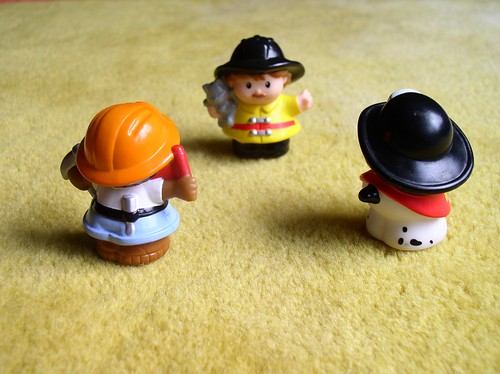
I want both of you to. . .
This style is used when leaders tell their employees what they want done and how they want it accomplished, without getting the advice of their followers. Some of the appropriate conditions to use it is when you have all the information to solve the problem, you are short on time, and your employees are well motivated.
Some people tend to think of this style as a vehicle for yelling, using demeaning language, and leading by threats and abusing their power. This is not the authoritarian style, rather it is an abusive, unprofessional style called “bossing people around.” It has no place in a leader's repertoire.
The authoritarian style should normally only be used on rare occasions. If you have the time and want to gain more commitment and motivation from your employees, then you should use the participative style.
Participative (democratic)
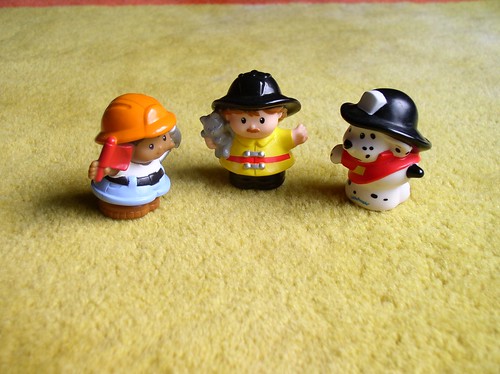
Let's work together to solve this. . .
This style involves the leader including one or more employees in the decision making process (determining what to do and how to do it). However, the leader maintains the final decision making authority. Using this style is not a sign of weakness, rather it is a sign of strength that your employees will respect.
This is normally used when you have part of the information, and your employees have other parts. Note that a leader is not expected to know everything — this is why you employ knowledgeable and skillful employees. Using this style is of mutual benefit — it allows them to become part of the team and allows you to make better decisions.
Delegative (free reign)
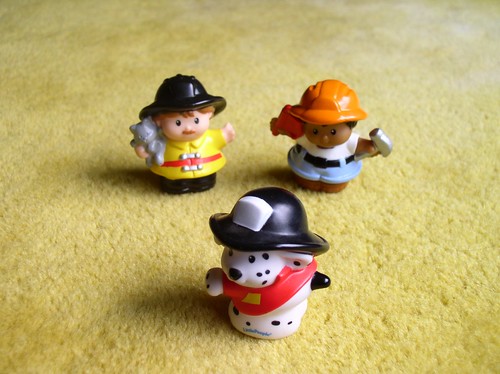
You two take care of the problem while I go. . .
In this style, the leader allows the employees to make the decisions. However, the leader is still responsible for the decisions that are made. This is used when employees are able to analyze the situation and determine what needs to be done and how to do it. You cannot do everything! You must set priorities and delegate certain tasks.
This is not a style to use so that you can blame others when things go wrong, rather this is a style to be used when you fully trust and confidence in the people below you. Do not be afraid to use it, however, use it wisely!
NOTE: This is also known as laissez faire (or lais·ser faire), which is the noninterference in the affairs of others. [French : laissez, second person pl. imperative of laisser, to let, allow + faire, to do.]
Forces
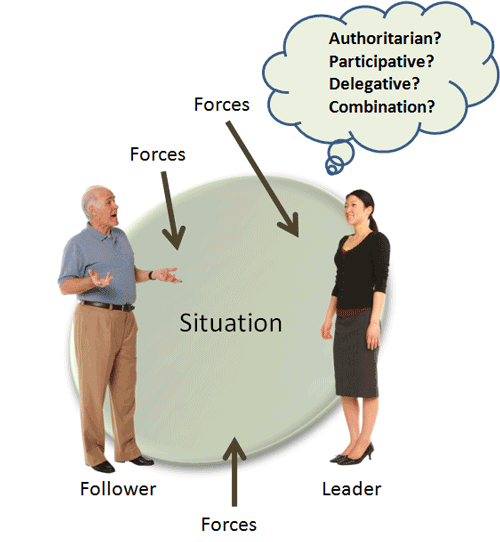
A good leader uses all three styles, depending on what forces are involved between the followers, the leader, and the situation. Some examples include:
- Using an authoritarian style on a new employee who is just learning the job. The leader is competent and a good coach. The employee is motivated to learn a new skill. The situation is a new environment for the employee.
- Using a participative style with a team of workers who know their job. The leader knows the problem, but does not have all the information. The employees know their jobs and want to become part of the team.
- Using a delegative style with a worker who knows more about the job than you. You cannot do everything and the employee needs to take ownership of her job! In addition, this allows you to be at other places, doing other things.
- Using all three: Telling your employees that a procedure is not working correctly and a new one must be established (authoritarian). Asking for their ideas and input on creating a new procedure (participative). Delegating tasks in order to implement the new procedure (delegative).
Forces that influence the style to be used included:
- How much time is available.
- Are relationships based on respect and trust or on disrespect?
- Who has the information — you, your employees, or both?
- How well your employees are trained and how well you know the task.
- Internal conflicts.
- Stress levels.
- Type of task. Is it structured, unstructured, complicated, or simple?
- Laws or established procedures such as OSHA or training plans.
Positive and Negative Approaches
There is a difference in ways leaders approach their employee. Positive leaders use rewards, such as education, independence, etc. to motivate employees. While negative employers emphasize penalties. While the negative approach has a place in a leader's repertoire of tools, it must be used carefully due to its high cost on the human spirit.
Negative leaders act domineering and superior with people. They believe the only way to get things done is through penalties, such as loss of job, days off without pay, reprimanding employees in front of others, etc. They believe their authority is increased by frightening everyone into higher levels of productivity. Yet what always happens when this approach is used wrongly is that morale falls; which of course leads to lower productivity.
Also note that most leaders do not strictly use one or another, but are somewhere on a continuum ranging from extremely positive to extremely negative. People who continuously work out of the negative are bosses while those who primarily work out of the positive are considered real leaders.
Use of Consideration and Structure
Two other approaches that leaders use are:
Consideration (employee orientation) — leaders are concerned about the human needs of their employees. They build teamwork, help employees with their problems, and provide psychological support.
Structure (task orientation) — leaders believe that they get results by consistently keeping people busy and urging them to produce.
There is evidence that leaders who are considerate in their leadership style are higher performers and are more satisfied with their job (Schriesheim, 1982).
Also notice that consideration and structure are independent of each other, thus they should not be viewed on opposite ends of a continuum. For example, a leader who becomes more considerate, does not necessarily mean that she has become less structured.
See Blake and Mouton's Managerial Grid as it is also based on this concept.
Paternalism
Paternalism has at times been equated with leadership styles. Yet most definitions of leadership normally state or imply that one of the actions within leadership is that of influencing. For example, the Army uses the following definition:
The Army further goes on by defining “influence” as:Leadership is influencing people — by providing purpose, direction, and motivation — while operating to accomplish the mission and improving the organization.
a means of getting people to do what you want them to do. It is the means or method to achieve two ends: operating and improving. But there is more to influencing than simply passing along orders. The example you set is just as important as the words you speak. And you set an example — good or bad — with every action you take and word you utter, on or off duty. Through your words and example, you must communicate purpose, direction, and motivation.
While “paternalism” is defined as (Webster):a system under which an authority undertakes to supply needs or regulate conduct of those under its control in matters affecting them as individuals as well as in their relationships to authority and to each other.
Thus paternalism supplies needs for those under its protection or control, while leadership gets things done. The first is directed inwards, while the latter is directed outwards.
Geert Hofstede (1977) studied culture within organizations. Part of his study was on the dependence relationship or Power Difference — the extent to which the less powerful members of an organization expect and accept that power is distributed unequally. Hofstede gave this story to illustrate this Power Difference:
The last revolution in Sweden disposed of King Gustav IV, whom they considered incompetent, and surprising invited Jean Baptise Bernadotte, a French general who served under Napoleon, to become their new King. He accepted and became King Charles XIV. Soon afterward he needed to address the Swedish Parliament. Wanting to be accepted, he tried to do the speech in their language. His broken language amused the Swedes so much that they roared with laughter. The Frenchman was so upset that he never tried to speak Swedish again.
Bernadotte was a victim of culture shock — never in his French upbringing and military career had he experienced subordinates who laughed at the mistakes of their superior. This story has a happy ending as he was considered very good and ruled the country as a highly respected constitutional monarch until 1844. (His descendants still occupy the Swedish throne.)
Sweden differs from France in the way its society handles inequality (those in charge and the followers). To measure inequality or Power Difference, Hofstede studied three survey questions from a larger survey that both factored and carried the same weight:
- Frequency of employees being afraid to express disagreement with their managers.
- Subordinates' perception of their boss's actual decision making style (paternalistic style was one choice).
- Subordinates' preference for their boss's decision-making style (again, paternalistic style was one choice).
He developed a Power Difference Index (PDI) for the 53 countries that took the survey. Their scores range from 11 to 104. The higher the number a country received, the more autocratic and/or paternalistic the leadership, which of course relates to employees being more afraid or unwilling to disagree with their bosses. While lower numbers mean a more consultative style of leadership is used, which translates to employees who are not as afraid of their bosses.
For example, Malaysia has the highest PDI score, being 104, while Austria has the lowest with 11. And of course, as the story above illustrates, Sweden has a relative low score of 31, while France has a PDI of 68. The USA's is 40. Note that these scores are relative, not absolute, in that relativism affirms that one culture has no absolute criteria for judging activities of another culture as “low” or “noble”.
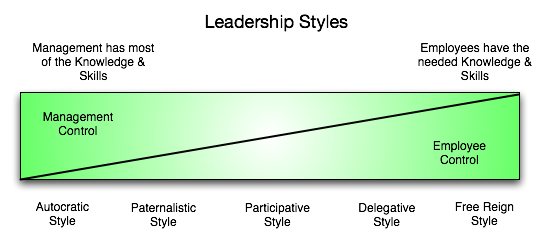
Keeping the above in mind, it seems that some picture paternalistic behavior as almost a barbaric way of getting things accomplished. Yet, leadership is all about getting things done for the organization. And in some situations, a paternalistic style of decision-making might be required; indeed, in some cultures and individuals, it may also be expected by not only those in charge, but also the followers. That is what makes leadership styles quite interesting — they basically run along the same continuum as Hofstede's PDI, ranging from paternalistic to consultative styles of decision making. This allows a wide range of individual behaviors to be dealt with, ranging from beginners to peak performers. In addition, it accounts for the fact that not everyone is the same.
However, when paternalistic or autocratic styles are relied upon too much and the employees are ready and/or willing to react to a more consultative type of leadership style, then it normally becomes quite damaging to the performance of the organization.
Source:
http://www.nwlink.com/~donclark/leader/leadstl.html
Comment:
I think participative is the best style, because it combines authoritarian and delegative style. In participative style, management and employee control have the same portion. The leaders can make the employee/s to be a part of the team, so that will make the leader to take a better decision.
Indonesian President calls for SMS support for Komodo

The president of Indonesia, Susilo Bambang Yudhoyono, has asked all Indonesians to support Komodo Island, one of the 28 Official Finalists in the New7Wonders of Nature.
The president made the appeal when he was officially inaugurating the new Lombok International Airport. According to The Jakarta Post, he asked the dignitaries present, and Indonesians in general, to vote for Komodo Island via SMS. “Let’s all type KOMODO and send it to 9818,” president Yudhoyono said during the event, which was also attended by former vice president Jusuf Kalla, who has been tasked with generating support for Komodo in the New7Wonders of Nature campaign.
Commentar :
Thank's Mr. President, this is a good effort from you. He still promote Komodo Island on that inauguration event. And his effort was not in vain, because Komodo Island finally was chosen as one of New 7 Wonders on 11 november ago. The formal announcement of New 7 Wonders will be held on this january.
Senin, 02 Januari 2012
Epson EH-TW3200
When we looked at Epson’s EH-TW3600 back in November, we couldn’t help but moan that while it was fine so far as it went, what we really wanted to see were the new Epson Reflective LCD models that created such a stir at last year’s IFA show in Berlin. Skip forward four long months - and still there’s no sign of any Reflective LCD action. Bah.
Epson seems to feel our pain, though, and so has kindly helped us fill our Reflective LCD void with another standard LCD model: the EH-TW3200. And actually, the more we look at this initially unassuming model, the more it seems to have going for it.
The most dominant part of its appeal is its price. For we’ve found it going for under £1,000 - startlingly cheap for a projector from a pedigree brand that boasts a high contrast ratio of 25,000:1, a potent brightness of 1,800 Lumens, and reassuring three-year lamp and two-year projector warranties.
The TW3200 will satisfy anyone who measures value by sheer volume, too. For surprisingly it sports the same hulking chassis as the TW3600 and other models higher up Epson’s current range. This isn’t all good news, as we have to say we’re not great fans of Epson’s present aesthetic direction, finding it rather chunky and inelegant. But we’ll be more than happy to overlook this if the TW3200 performs as well as we’re hoping it might.
This full HD projector’s connections are perfectly respectable, too. You get the same twin HDMI support that you get with models right up to Epson’s high-end EH-TW5500, along with an S-Video input, a component video input, a D-Sub PC port, a 3.5mm mini-jack, and an RS232 control jack.
So far, we’ve found absolutely nothing that might explain how Epson could have made the TW3200 so affordable. And this theme continues as we go about setting it up, for it benefits from an excellent x2.1 optical zoom, and loads of manual image shift in both vertical and horizontal directions.
Sumber : http://www.trustedreviews.com/Epson-EH-TW3200_Projector_review
Komentar:
Proyektor ini memiliki optikal zoom yang sangat baik dan kecerahan yang tinggi, selain itu juga memiliki fasilitas lainnya yang cukup baik. Dengan fasilitas tersebut, banyak orang yang mengira bahwa proyektor tersebut mahal, namun ketika disebutkan harganya orang tidak percaya bahwa harganya sangatlah murah (pada kelasnya).
Senin, 28 November 2011
Banjir atau Genangan?

My Opinion:
Banjir(flooding) or Genangan(Inundation)? I think both are the same thing, it are equally detrimental to us. So the problem is why the flooding or inundation could occur?. It is caused by several factors, including residents who dispose of garbage and lack of water catchment areas. The Government must find a solution as quick as possible, so it can soon be overcome, so that people can feel safe from flooding or "inundation".
Sleep Well in Meeting

My opinion about the picture above :
I think that is a very embarrassing moment, they show us a bad example. They sleep well when there are still many Indonesian people living in poverty. They are paid not to sleep, but to think their people. They should show good attitude when meeting. But in the other hand, I'm sure that a lot of them who still fight for Indonesian people.
Jumat, 18 November 2011
If Clause dan Wish Beserta Faktanya
1. If-Clause Type
Type 1 :
Conditional Sentences Type I refer to the future. An action in the future will only happen if a certain condition is fulfilled by that time. We don't know for sure whether the condition actually will be fulfilled or not, but the conditions seems rather realistic – so we think it is likely to happen.
Form : If + Smple present, will-future
Example : If I find her address, I will send her an invitation.
Type 2 :
Conditional Sentences Type II refer to situations in the present. An action could happen if the present situation were different. I don't really expect the situation to change, however. I just imagine "what would happen if..."
Form : If + Simple past, main clause with conditional I (=would + invinitive)
Example : If I found her address, I would send her an invitation.
Type 3 :
Conditional Sentences Type III refer to situations in the past. An action could have happened in the past if a certain condition had been fulfilled. Things were different then, however. We just imagine, what would have happened if the situation had been fulfilled.
Form : If + Past Perfect, main clause with conditional II
Example : If I had found her address, I would have sent her an invitation. [1]
2. Wish
Type 1 :
Conditional Sentences Type I refer to the future. An action in the future will only happen if a certain condition is fulfilled by that time. We don't know for sure whether the condition actually will be fulfilled or not, but the conditions seems rather realistic – so we think it is likely to happen.
Form : If + Smple present, will-future
Example : If I find her address, I will send her an invitation.
Type 2 :
Conditional Sentences Type II refer to situations in the present. An action could happen if the present situation were different. I don't really expect the situation to change, however. I just imagine "what would happen if..."
Form : If + Simple past, main clause with conditional I (=would + invinitive)
Example : If I found her address, I would send her an invitation.
Type 3 :
Conditional Sentences Type III refer to situations in the past. An action could have happened in the past if a certain condition had been fulfilled. Things were different then, however. We just imagine, what would have happened if the situation had been fulfilled.
Form : If + Past Perfect, main clause with conditional II
Example : If I had found her address, I would have sent her an invitation. [1]
2. Wish
Ini digunakan untuk menyatakan PENGANDAIAN/PENGHARAPAN pada waktu lampau/menyesali sesuatu yang telah terjadi/menyesali karena tidak terjadi, walaupun itu semua hanya sebatas HARAPAN PENGANDAIAN saja, karena memang hal itu tidak terjadi pada waktu lampau, seperti yang DIHARAPKAN itu, hanya MENGANDAIKAN saja.
Untuk menyatakan hal yang telah terjadi pada waktu lampau, yang jika dalam kalimat biasa/nyata digunakan verb-2; seperti DID dan SEJENISNYA (enjoyed, studied, visited, went dan saw), maka dalam kalimat subjunctive-nya atau ‘WISHES-nya ini dipakai bentuk past perfect; yaitu ‘HAD DONE’ dan SEJENISNYA {had enjoyed, had studied, had visited, had gone dan had seen) di depan Subject 2, atau sesudah kata ‘wish’.
Untuk to be; (WAS/WERE +NV=Non Verb/bukan kata kerja) pada WAKTU LAMPAU pada kalimat SEBENARNYA, maka pada kalimat subjunctive 'wishes'-nya ini digunakan bentuk LEBIH LAMPAU yaitu: HAD BEEN+NV=Non Verb.
Kesimpulan; Jika pada kalimat sebenarnya/keadaan SEBENARNYA itu dalam keadaan LAMPAU/past, maka dalam keadaan pengandaian ‘WISH’nya itu LEBIH LAMPAU/past perfect. [2]
Rumus :
Subject 1+ wish (that) + subject 2 + (modal-2)+have +V3.
Subject 1+ wish (that) + subject 2 + (modal-2) +have +been+NV
Subject 1+ wish (that) + subject 2 + had +V3
Subject 1+ wish (that) + subject 2 + had +been+NV
3. The Example
- She wishes her mother would come.
The fact : Her mother isn't here.
- He wishes his friend were here.
The fact : His friens isn't here.
- Sinta wishes her father had been here.
The fact : Her father haven't been here.
- Andy wishes his brother would have come.
The fact : His brother didn't come.
- She wished her mother had been here.
The fact : Her mother haven't been here.
- He wished his brother would have come.
The fact : His brother didn't come.
- He plays as if he were a professional.
The fact : He isn't a professional.
- She seemed as though she had worked hard.
The fact : She haven't worked hard.
- She talks as if she knew about polities.
The fact : She doesn't know about polities.
- I would rather she were here.
The fact : She isn't here.
- I would rather it had not been holiday yesterday.
The fact : I haven't been holiday. [3]
Source :
[1] http://www.ego4u.com/en/cram-up/grammar/conditional-sentences
[2] http://basyirdotcom.blogspot.com/2010/10/kalimat-pengandaian6subjunctive.html
[3] http://rubahputih.blogspot.com/2011/04/subjunctive.html
Untuk menyatakan hal yang telah terjadi pada waktu lampau, yang jika dalam kalimat biasa/nyata digunakan verb-2; seperti DID dan SEJENISNYA (enjoyed, studied, visited, went dan saw), maka dalam kalimat subjunctive-nya atau ‘WISHES-nya ini dipakai bentuk past perfect; yaitu ‘HAD DONE’ dan SEJENISNYA {had enjoyed, had studied, had visited, had gone dan had seen) di depan Subject 2, atau sesudah kata ‘wish’.
Untuk to be; (WAS/WERE +NV=Non Verb/bukan kata kerja) pada WAKTU LAMPAU pada kalimat SEBENARNYA, maka pada kalimat subjunctive 'wishes'-nya ini digunakan bentuk LEBIH LAMPAU yaitu: HAD BEEN+NV=Non Verb.
Kesimpulan; Jika pada kalimat sebenarnya/keadaan SEBENARNYA itu dalam keadaan LAMPAU/past, maka dalam keadaan pengandaian ‘WISH’nya itu LEBIH LAMPAU/past perfect. [2]
Rumus :
Subject 1+ wish (that) + subject 2 + (modal-2)+have +V3.
Subject 1+ wish (that) + subject 2 + (modal-2) +have +been+NV
Subject 1+ wish (that) + subject 2 + had +V3
Subject 1+ wish (that) + subject 2 + had +been+NV
3. The Example
- She wishes her mother would come.
The fact : Her mother isn't here.
- He wishes his friend were here.
The fact : His friens isn't here.
- Sinta wishes her father had been here.
The fact : Her father haven't been here.
- Andy wishes his brother would have come.
The fact : His brother didn't come.
- She wished her mother had been here.
The fact : Her mother haven't been here.
- He wished his brother would have come.
The fact : His brother didn't come.
- He plays as if he were a professional.
The fact : He isn't a professional.
- She seemed as though she had worked hard.
The fact : She haven't worked hard.
- She talks as if she knew about polities.
The fact : She doesn't know about polities.
- I would rather she were here.
The fact : She isn't here.
- I would rather it had not been holiday yesterday.
The fact : I haven't been holiday. [3]
Source :
[1] http://www.ego4u.com/en/cram-up/grammar/conditional-sentences
[2] http://basyirdotcom.blogspot.com/2010/10/kalimat-pengandaian6subjunctive.html
[3] http://rubahputih.blogspot.com/2011/04/subjunctive.html
Conditional Sentences
1. Definiton of Conditional Sentences
In grammar, conditional sentences are sentences discussing factual implications or hypothetical situations and their consequences. Languages use a variety of conditional constructions and verb forms (such as the conditional mood) to form such sentences.
2. The Types of Conditional Sentences
Conditional Sentence Type 1 :
It is possible and also very likely that the condition will be fulfilled. Conditional Sentences Type I refer to the future. An action in the future will only happen if a certain condition is fulfilled by that time. We don't know for sure whether the condition actually will be fulfilled or not, but the conditions seems rather realistic – so we think it is likely to happen.
Example : If I find her address, I’ll send her an invitation.
Conditional Sentence Type 2 :
It is possible but very unlikely that the condition will be fullfilled. Conditional Sentences Type II refer to situations in the present. An action could happen if the present situation were different. I don't really expect the situation to change, however. I just imagine „what would happen if …“
Example : If I found her address, I would send her an invitation.
Conditional Sentence Type 3 :
It is impossible that the condition will be fulfilled because it refers to the past. Conditional Sentences Type III refer to situations in the past. An action could have happened in the past if a certain condition had been fulfilled. Things were different then, however. We just imagine, what would have happened if the situation had been fulfilled.
Example : If I had found her address, I would have sent her an invitation.
3. The Example of Conditional Sentences
Source :
http://www.ego4u.com/en/cram-up/grammar/conditional-sentences
http://en.wikipedia.org/wiki/Conditional_sentence
http://ismailmidi.com/berita-140-conditional-sentences.html
In grammar, conditional sentences are sentences discussing factual implications or hypothetical situations and their consequences. Languages use a variety of conditional constructions and verb forms (such as the conditional mood) to form such sentences.
Full conditional sentences contain two clauses: the condition or protasis, and the consequence or apodosis.
- If it rains [condition], (then) the picnic will be cancelled [consequence].
2. The Types of Conditional Sentences
Conditional Sentence Type 1 :
It is possible and also very likely that the condition will be fulfilled. Conditional Sentences Type I refer to the future. An action in the future will only happen if a certain condition is fulfilled by that time. We don't know for sure whether the condition actually will be fulfilled or not, but the conditions seems rather realistic – so we think it is likely to happen.
Example : If I find her address, I’ll send her an invitation.
Conditional Sentence Type 2 :
It is possible but very unlikely that the condition will be fullfilled. Conditional Sentences Type II refer to situations in the present. An action could happen if the present situation were different. I don't really expect the situation to change, however. I just imagine „what would happen if …“
Example : If I found her address, I would send her an invitation.
Conditional Sentence Type 3 :
It is impossible that the condition will be fulfilled because it refers to the past. Conditional Sentences Type III refer to situations in the past. An action could have happened in the past if a certain condition had been fulfilled. Things were different then, however. We just imagine, what would have happened if the situation had been fulfilled.
Example : If I had found her address, I would have sent her an invitation.
3. The Example of Conditional Sentences
- If John has the money, he will buy a Ferrari.
- If I won the lottery, I would buy a car.
- If he said that to me, I would run away.
- If you had called me, I would have come.
- If Gimli studies hard, he will pass the exam.
- If I see you tomorrow, I will buy you a drink.
- If I have time today, I will phone my friend.
- If I go to England, I will buy some Cheddar chese.
- If I had more time, I would do more on my websites.
- If I have the time, I will go.
Source :
http://www.ego4u.com/en/cram-up/grammar/conditional-sentences
http://en.wikipedia.org/wiki/Conditional_sentence
http://ismailmidi.com/berita-140-conditional-sentences.html
The Example of Negative and Interrogative of Passive Sentence
1. Negative
-They aren't met by him everyday.
-This plant isn't watered by her every two days.
-Football wasn't played by him yesterday.
-The book wasn't read by her this morning.
-The test hasn't been finished by him.
-The lazy boy hasn't been punished by her.
-They hadn't been told by him before I came.
-This plant hadn't been sold by her when I got here.
-I won't be married by him tomorrow.
-The Case won't be closed by The Police.
2. Interrogative
-Are they met by him everyday.
-Is this Plant watered by her every two days?
-Was football played by him yesterday?
-Was the book read by her this morning?
-Has the test been finished by him?
-Has the lazy boys been punished by her?
-Had they been told by him before I came?
-Had the plant been sold by her when I got here?
-Will I be married by him tomorrow?
-Will the case be closed by The Police?
http://swarabhaskara.com/miscellaneous/active-and-passive-voice/
-They aren't met by him everyday.
-This plant isn't watered by her every two days.
-Football wasn't played by him yesterday.
-The book wasn't read by her this morning.
-The test hasn't been finished by him.
-The lazy boy hasn't been punished by her.
-They hadn't been told by him before I came.
-This plant hadn't been sold by her when I got here.
-I won't be married by him tomorrow.
-The Case won't be closed by The Police.
2. Interrogative
-Are they met by him everyday.
-Is this Plant watered by her every two days?
-Was football played by him yesterday?
-Was the book read by her this morning?
-Has the test been finished by him?
-Has the lazy boys been punished by her?
-Had they been told by him before I came?
-Had the plant been sold by her when I got here?
-Will I be married by him tomorrow?
-Will the case be closed by The Police?
http://swarabhaskara.com/miscellaneous/active-and-passive-voice/
Kamis, 17 November 2011
Intransitive Verb
1. Definition of Intransitive Verb
An intransitive verb has two characteristics. First, it is an action verb, expressing a doable activity like arrive, go, lie, sneeze, sit, die, etc. Second, unlike a transitive verb, it will not have a direct object receiving the action. [1]
An intransitive verb has two characteristics. First, it is an action verb, expressing a doable activity like arrive, go, lie, sneeze, sit, die, etc. Second, unlike a transitive verb, it will not have a direct object receiving the action. [1]
A verb (such as laugh) that does not take a direct object or complement. Contrast with transitive verb.
Many verbs have both a transitive and an intransitive function, depending on how they are used. The verb break, for instance, sometimes takes a direct object ("Rihanna breaks my heart") and sometimes does not ("When I hear your name, my heart breaks"). [2]
2. Categories of Intransitive Verb
-Kata kerja intransitif yang mana saja, yang membuat pengertian lengkap dengan sendirinya, dan tidak memerlukan kata atau kata-kata apa saja untuk ditambahkan padanya untuk maksud ini, disebut intransitive verbs of complete predication.
Contoh:
Cows walk,
horses run, dsb.
-Intransitive verb with complement (kata kerja intransitif dengan komplemen)
Kata-kata kerja intransitif yang tidak membuat pengertian yang lengkap dengan sendirinya, tetapi memerlukan komplemen, disebut intransitive verbs of incomplete predication.
Komplemen untuk kata kerja intransitif dalam bentuk yang sama jenisnya seperti komplemen untuk kata kerja transitif.
Subject | Verb | Complement |
-The cognate object (objek yang sama asalnya, sifatnya atau artinya)
Kata kerja intransitif kadang-kadang boleh diikuti oleh kata benda yang sedikit banyak telah dinyatakan secara tidak langsung dalam kata kerja itu sendiri.
Jadi kita boleh mengatakan “He has lived a happy life” (ia hidup bahagia). Kata benda “life” (kehidupan) telah dinyatakan secara tidak langsung dalam kata kerja “lived” (hidup), dan sebenarnya merupakan bagian dari artinya.
Objek yang demikian disebut cognate object, karena kata benda yang menunjuk padanya merupakan arti yang sama terhadap kata kerja itu sendiri. [3]
3. The Example
-Rosa always eats before leaving for school.
-Damien runs over hills, through fields, across the river, and along the highway. [1]
-Sometimes imagination pounces; mostly it sleeps soundly in the corner, purring.
-The lion sleeps tonight.
-Do not tremble in fear but become strong and courageous instead. [2]
-Aragon sleep well.
-Gandalf returns to The Middle Earth.
-Frodo walks quickly
-Legolas fall to the river.
-Sauron wakes in the morning.
Source :
[1] http://www.chompchomp.com/terms/intransitiveverb.htm
[2] http://grammar.about.com/od/il/g/intranterm.htm
[3] http://www.englishgrammar-exercises.com/Verbs_intransitive1.php
Selasa, 15 November 2011
Transitive Verb
1. Definition of Transitive Verb
A verb that takes an object (direct or indirect). Contrast with intransitive verb.
Many verbs have both a transitive and an intransitive function, depending on how they are used. The verb break, for instance, sometimes takes a direct object ("Rihanna breaks my heart") and sometimes does not ("When I hear your name, my heart breaks"). [1]
A transitive verb has two characteristics. First, it is an action verb, expressing a doable activity like kick, want, paint, write, eat, clean, etc. Second, it must have a direct object, something or someone who receives the action of the verb.
Here are some examples of transitive verbs:
Sylvia kicked Juan under the table.
Kicked = transitive verb; Juan = direct object.
Joshua wants a smile from Leodine, his beautiful but serious lab partner.
Wants = transitive verb; smile = direct object.
Cornelius painted the canvas in Jackson Pollock fashion, dribbling bright colors from a heavily soaked brush.
Painted = transitive verb; canvas = direct object. [2]
2. Sub-types of Transitive verb
Among transitive verbs there are three sub-types:
- Monotransitive verbs have only a direct object.
- Ditransitive verbs have a direct object and an indirect or benefactive object.
- Complex-transitive verbs have a direct object and an object attribute.
3. Some examples of sentences with transitive verbs
- Alicia wrote a love poem on a restaurant napkin.
- Antonio eats lima beans drenched in brown gravy.
- Pinky the poodle cleans the dirty supper dishes with his tongue.
- Grandma loads the "prewashed" items into dishwasher. [2]
- You pushed the bag.
- I hate you.I gave you the doll.
- I ate the pie.
- I tried on the shoes. [3]
- I know the muffin man.
- We lost a daughter but gained a meathead.
- Parents lend children their experience and a vicarious memory.
- I punched Mickey Mantle in the mouth.
- A musicologist is a man who can read music but can't hear it. [1]
- Randi have won the match last night.
[1] http://grammar.about.com/od/tz/g/tranverb02term.htm
[2] http://www.chompchomp.com/terms/transitiveverb.htm
[3] http://en.wikipedia.org/wiki/Transitive_verb
Minggu, 13 November 2011
Tugas 5 : The Article
SUBJECT = ITALIC
VERB = RED
COMPLEMENT = BOLD
MODIFIER = GREEN
The article from Goal.com :
Ajax's Christian Eriksen: Every player dreams of Barcelona
The Denmark International has admitted that a move to Camp Nou is tempting and feels he would fit in well, but added that he is in no rush to leave his current club
Ajax star Christian Eriksen said he would be open to a transfer to Barcelona, but added that he still has plenty of things to achieve at his current club.
Although Eriksen has admitted that wearing the Barcelona jersey is a dream for most players, he is not in a rush to make the move to Camp Nou.
"I think that most footballers dream of playing for Barcelona," Eriksen was quoted as saying by sporten.dk.
"I think that Barcelona's style would fit me very well and a transfer to Camp Nou would be great. However, I still have plenty of challenges left with Ajax. We'll see what happens when the time is right to move on."
The 19-year-old playmaker recently revealed that he turned down an approach from Manchester City in the summer transfer window, while Manchester United, Arsenal and Chelsea are also believed to be keeping tabs on him.
Passive Voice
1. Definisi Passive Voice
Kalimat aktif (active voice) adalah kalimat dimana subject-nya melakukan pekerjaan, sebaliknya, kalimat pasif (passive voice) adalah kalimat dimana subject-nya dikenai pekerjaan oleh object kalimat. Active voice lebih sering digunakan dalam kehidupan sehari-hari dibandingkan dengan passive voice. Namun demikian, sering kita temukan passive voice di surat-surat kabar, artikel-artikel di majalah-majalah dan tulisan-tulisan ilmiah. Passive voice digunakan karena object dari active voice merupakan informasi yang lebih penting dibandingkan dengan subject-nya.
2. Bagaimana mengubah kalimat aktif menjadi kalimat pasif?
3. Contoh Kalimat
-Simple Present Tense
http://swarabhaskara.com/miscellaneous/active-and-passive-voice/
Kalimat aktif (active voice) adalah kalimat dimana subject-nya melakukan pekerjaan, sebaliknya, kalimat pasif (passive voice) adalah kalimat dimana subject-nya dikenai pekerjaan oleh object kalimat. Active voice lebih sering digunakan dalam kehidupan sehari-hari dibandingkan dengan passive voice. Namun demikian, sering kita temukan passive voice di surat-surat kabar, artikel-artikel di majalah-majalah dan tulisan-tulisan ilmiah. Passive voice digunakan karena object dari active voice merupakan informasi yang lebih penting dibandingkan dengan subject-nya.
2. Bagaimana mengubah kalimat aktif menjadi kalimat pasif?
Contoh :
- Active : We fertilize the soil every 6 months
- Passive: The soil is fertilized by us every 6 months
Dari contoh ini dapat kita lihat bahwa:
- Object dari active voice (the soil) menjadi subject dari passive voice
- Subject dari active voice (we) menjadi object dari passive voice. Perhatikan pula bahwa terjadi perubahan dari subject pronoun ‘we’ menjadi object pronoun ‘us’.
- Verb1 (fertilize) pada active voice menjadi verb3 (fertilized) pada passive voice.
- Ditambahkannya be ‘is’ di depan verb3. Be yang digunakan adalah tergantung pada subject passive voice dan tenses yang digunakan.
- Ditambahkannya kata ‘by’ di belakang verb3. Namun, jika object dari passive voice dianggap tidak penting atau tidak diketahui, maka object biasanya tidak dikemukakan dan begitu pula kata ‘by’.
- Khusus untuk kalimat-kalimat progressive (present, past, past perfect, future, past future, dan past future perfect continuous, perlu menambahkan ‘being’ di depan verb3). Kalau tidak ditambahkan “being”, tensisnya akan berubah, bukan progressive/continuous lagi.
Berdasarkan keenam poin di atas maka passive voice mengikuti pola sebagai berikut:
Subject + be + Verb3 + by + Object + modifier
3. Contoh Kalimat
-Simple Present Tense
- Active : He meets them everyday.
- Passive : They are met by him everyday.
- Active : She waters this plant every two days.
- Passive : This plant is watered by her every two days.
- Active : He played football yesterday
- Passive : Football was played by him yesterday.
- Active : She read the book this morning.
- Passive : the book was read by her this morning.
- Active : He has finished the test.
- Passive : The test has been finished by him.
- Active : She has punished the lazy boy.
- Passive : The lazy boy has been punished by her.
- Active : He had tell them before I came.
- Passive : They had been told by him before I came.
- Active : She had sold this plant when I got here.
- Passive : This plant had been sold by her when I got here.
- Active : He will marry me tomorrow.
- Passive : I will be married by him tomorrow.
- Active : The Police will close the case this afternoon.
- Passive : The Case will be closed by The Police.
http://swarabhaskara.com/miscellaneous/active-and-passive-voice/
Sabtu, 12 November 2011
Tugas 5 : The Article
SUBJECT = ITALIC
VERB = RED
COMPLEMENT = BOLD
MODIFIER = GREEN
The article from Goal.com :
Ajax's Christian Eriksen: Every player dreams of Barcelona
The Denmark International has admitted that a move to Camp Nou is tempting and feels he would fit in well, but added that he is in no rush to leave his current club
Ajax star Christian Eriksen said he would be open to a transfer to Barcelona, but added that he still has plenty of things to achieve at his current club.
Although Eriksen has admitted that wearing the Barcelona jersey is a dream for most players, he is not in a rush to make the move to Camp Nou.
"I think that most footballers dream of playing for Barcelona," Eriksen was quoted as saying by sporten.dk.
"I think that Barcelona's style would fit me very well and a transfer to Camp Nou would be great. However, I still have plenty of challenges left with Ajax. We'll see what happens when the time is right to move on."
The 19-year-old playmaker recently revealed that he turned down an approach from Manchester City in the summer transfer window, while Manchester United, Arsenal and Chelsea are also believed to be keeping tabs on him.
Langganan:
Postingan (Atom)